Showing posts with label Holmes and Watson. Show all posts

Tuesday, 14 May 2013

Shameless photography in lieu of real progress


The Royal North Surreys have been sitting in my painting tray for weeks now, without a photo of their latest paint; and also un-photographed are the (now undercoated) Aetherines I bought from Brigade a month or so back.

As the men of the Royal North Surrey check the perimeter, Captain Carruthers and Lieutenant  Pootling-Twelp confer with Captain Yates of UNIT, and sometimes the Northdale Rifles; Sergeant Bromsgrove looks on, while Colour Sergeant Jeffries guards Ensign Jensen and the Company Colours (flag from the Warflag site - a generic British flag from the Napoleonic Wars looked like the best bet - http://www.warflag.com/flags/napoleon/napbritain1.shtml ).


Captain and men of the Royal Aeronautical Corps "Aetherines", wondering why they are not currently in their habitual natty blue jackets and trousers. Simply because I haven't gotten round to painting them, that's why.


Bobbies from Scotland Yard, with their English Electric Truncheons, and officers of 'Special Branch' (I'm sure it was called the 'Special Irish Branch' at this point) with rifles, Inspector Le Strange (probably), the Good Doctor and the Consulting Detective, from North Star Military Figures' new 'In Her Majesty's Name' range.


Lord Curr's Company, a quixotic and mercenary company of ne'er-do-wells, disgruntled ex-servicemen, and aristocratic adventurers, including Lord Curr himself armed with an 'Arc rifle' (electric rifle), from North Star Military Figures.


Having recently taken delivery of North Star and Osprey's new 'In Her Majesty's Name', both the figures and the rulebook, coming so soon after my purchases of 'Various Victorians' and the Brigade Games British in Rebreathers a month or so ago, I feel quite faint with excitement at the cornucopia of VSF-y leaden goodness (they probably don't put lead in any more, probably showing my age there).

I certainly have a lot to paint in the coming months - and hardly a red coat in sight (it's quite possible I will paint up one of the 'Incorrigibles', Lord Curr's men, in a Rifles uniform, so I can use him for the Northdale Rifles or UNIT as necessary).

Others of Lord Curr's men I can easily see being pressed into service should I ever get any further with my long-touted VBCW project; they're very versatile figures I think, some of them could be from any period from about 1870-1940 or there abouts.

Tuesday, 17 July 2012

Newly-acquired forces...

Latest additions to the leadpile... quite when I shall paint them, who's to say?


Sherlock Holmes and some London Policemen from Westwind Games

Thanks to the lovely majorsmith at Lead Aventure Forums (who also supplied me with the Ironclad British Line Infantry ages ago that started this whole crazy business) for swapping these minis with me. A bit of a mixed bag here, the Westwind stuff will be perfect for those slightly more normal settings involving consulting detectives, the police, and angry London mobs (perhaps connected with the whole 'Food of the Gods' business).


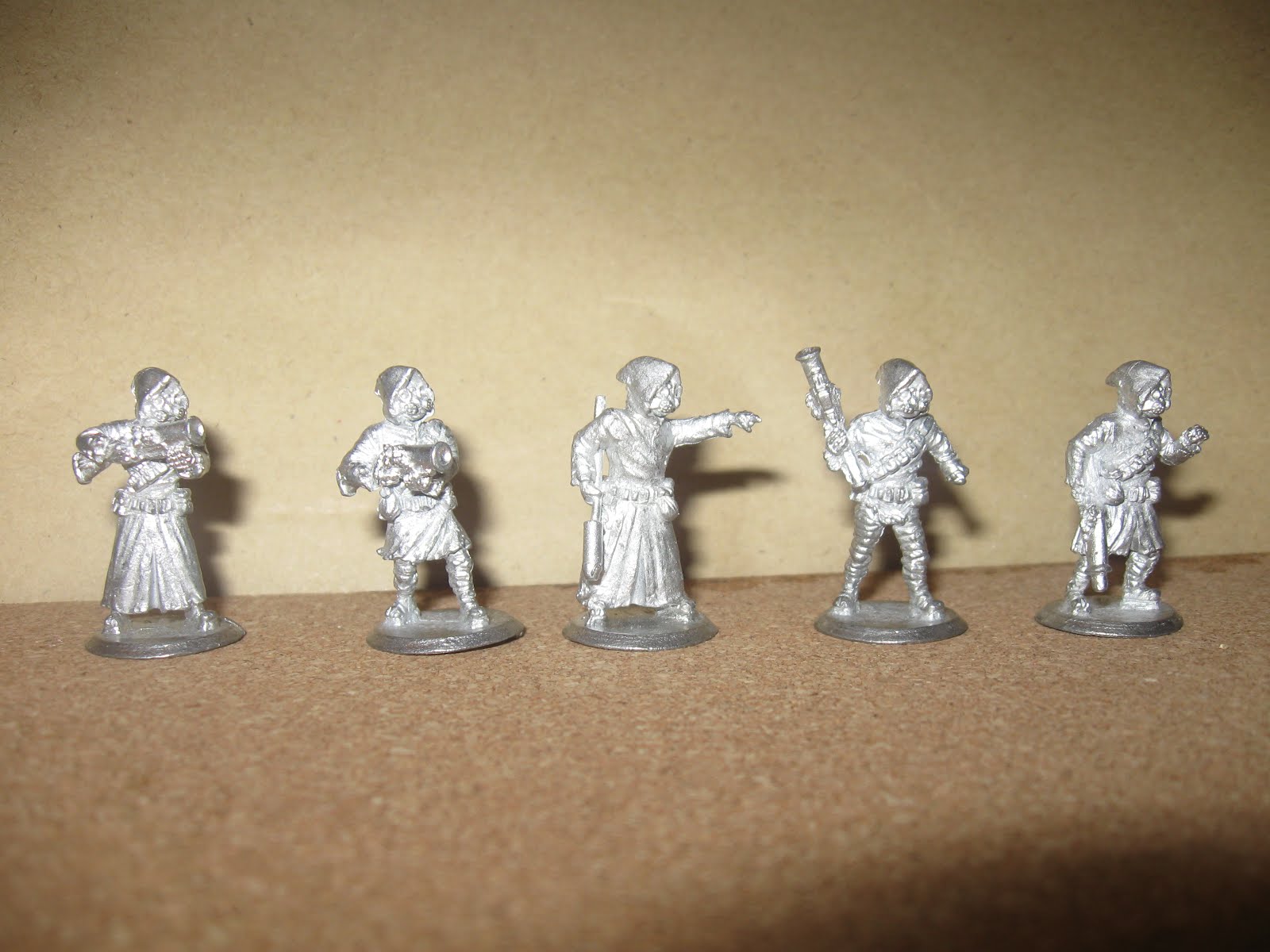
Sinister Prussians in Gasmasks from Ironclad Miniatures

The Prussians will of course be pressed into service for my Ruritanian forces, on Mars or some other sector of the Astro-Hungarian Empire. And the Sanwar too look like they'll make an interesting diversion on the Martian highways (or canals possibly). I feel a Martian campaign coming on...


Sinister 'Sanwar', Martian desert dwellers from Ironclad Miniatures


Wednesday, 4 April 2012

Strelsau Police Issue Photograph of Anarchist Plotters


The Chief of Police in Strelsau has taken the unusual step of issuing a photograph of four men thought to be involved with revolutionary activity among the working classes in Ruritania.

Following the recent announcement by the Paris-based 'People's Truth' group that they opposed the recent campaign of terrorist outrages, the international revolutionary socialist movement has been riven by a dispute between those who support 'direct action' - a euphemism for terrorism - and those who support factory organisations to wrest control of industry from the bosses.

These four men are believed to be from the direct action wing of the revolutionary socialist movement and active in Strelsau. All loyal citizens of Ruritania are asked to be vigilant and report anything suspicious to the authorities!

Friday, 30 December 2011

Sherlock Holmes, Atlantis, and... Dwarves?

Inspired by the latest round of the Robert Downey Jr/Jude Law Holmes & Watson caper ('Sherlock Holmes: A Game of Shadows', available at all good Kinematographic Projection Emporia and Electric Theatres), especially as it seemed to be set exactly 120 years before I watched it (like the Atlantis campaign over at the Lead Adventure Forum) I decided it would be fun to tie the two together in order to round off the Atlantis capmaign.


As a result, I uploaded this, from the London Evening Messenger of December 20th, 1891, to the LAF site, with the rest of the text as it (somewhat inexplicably) breaks off with "... German E ..." and then stops. "Empire" of course. And then some more words, which you'll have to visit LAF to find out about, probably.

Anyway and such, the idea had entered my head of there being a peace conference at Reichenbach, where the fate of the Interventions on Atlantis was to be decided. And so it is; for the next few days at least, the Castle of Reichenbach will play host to a peace conference involving Britain, France, Russia, Germany, USA, CSA, Japan, China, Spain, and the Caliphate of Khosind (a small North African state which declared its independence from France some years ago, apparently), all of which have forces in the field in Atlantis, and at the very least Austria-Hungary, which doesn't, but is keen to discuss among other topics the Ruritanian Question.

So if there is to be Peace in Our Time, with Chancellors and Prime Ministers flying by aeronef back and forth carrying pieces of paper bearing the forged signatures of heads of state, it may be that I can finally draw the Atlantis Campaign to a close. Which brings me to the subject of Her Majesty's Native Forces, enlisted as soldiers of the Queen during the campaign. I have gotten a few steps closer to finishing them, and would like to present, for the first time anywhere, a sketchy but still colourful Daguerrotype of the Morlock Allied Native Infantry Corps (part of the Combined Atlantean Rifle Brigade).


Wearing old kit from the Zulu War and only now retrieved from storage, they are a little out of place in the brash modern world of 1891, but I don't really mind that much. They'll make a fine addition I think to the Thin Red Line (or in their case, the Quite Short but Stought Red Line).

Plans obviously are now to base them, and stat them up for GASLIGHT - shouldn't be too hard, they may be Dwarves, but they're British Dwarves, don'ch'know?

Wednesday, 7 December 2011

Medals galore!

In attempting to sort out the Victorian histories of various fictional characters, I've looked at two, to start with, General Melchett (Blackadder) and Lance-Corporal Jones (Dad's Army).

General Sir Anthony Cecil Hogmanay Melchett:

info from Wiki here: http://en.wikipedia.org/wiki/Melchett and the discussions here: http://en.wikipedia.org/wiki/Talk:Melchett:

Victoria Cross, the Order of the Bath (KCB), Distinguished Service Order

the campaign medals, which are worn in order of the campaign for which they are awarded: the South Africa Medal awarded for service in the Anglo-Zulu War. Next is the red-green-red of the Afghanistan Medal (1878-80); the East and West Africa Medal, awarded from services in the region from 1887 onward; the blue-and-white Egypt Medal (1882-89); the Khedive's Star, which was awarded by the Khedive of Egypt to personnel who also qualified for the Egypt Medal; the red-green-red-green-red of the India Medal (1896).

Queen's South Africa Medal (1899), King's South Africa Medal, India General Service Medal, the 1914 Star


Corporal Jones:

info from here: http://en.wikipedia.org/wiki/Lance-Corporal_Jack_Jones

Joined the army as a drummer boy in 1884; Mahdist War in the Sudan (1884–1885) - Egypt Medal (1882–1889), Khedive's Sudan Medal (1882–1891)

the British Reconquest of Sudan (1896–1899) - Queen's Sudan Medal (1897), Khedive's Sudan Medal (1897)

the Boer War (1899–1901) - Queen's South African War Medal(1899–1902), King's South African War Medal (1901–1902)

He also once formed part of a Guard of Honour for Queen Victoria.

the First World War (1914–1918)- 1914 Star (or 1914–15 Star), British War Medal, Allied Victory Medal, Long Service and Good Conduct Medal

Occasionally he mentions fighting the Pathans in the North-West Frontier (he is probably referring to either the Second or the Third Anglo-Afghan War)... India Medal(1895–1902), India General Service Medal (1909) and then WWI medals.


I have assumed he cannot have served in the Third Anglo-Afghan War as he was invalided out of the Army in 1916, and the Third Anglo-Afghan War was fought in 1919. But the Second Anglo-Afghan War (1878-80, in which Sherlock Holmes's companion Dr Watson was injured) was before Jones joined up. However, there were numerous campaigns and actions from 1888-1908 in the North-West Frontier Province, especially between 1895-1902, and Jones could have been involved in more than one of these.


There is thus a close correspondence between Melchett's and Jones's medals - if as I have assumed the 'Khedive's Star' is the same as the 'Khedive's Sudan Medal' etc.

A list of correspondences is as follows (sadly as I can't sort out the formatting it's a little difficult to read):

Melchett / Jones / Year(s)
Egypt Medal / Egypt Medal / 1882-89
Khedive's Star / Khedive's Sudan Medal / 1882-91
East and West Africa Medal /(none) / 1887-1900
India Medal / India Medal / 1895-1902
(none) / Queen's Sudan Medal / 1896-98
(none) / Khedive's Sudan Medal / 1897
Queen's South Africa Medal / Queen's South Africa Medal / 1899-1902
King's South Africa Medal / King's South Africa Medal / 1901-02
India General Service Medal / India General Service Medal / 1908-1935
1914 Star / 1914 or 1914-15 Star / 1917 or 1918

These military careers are very similar, in many ways. Apart from the years 1890-99 they seem very close, and even in this period both served in India (receiving the India Medal) and in Africa (Jones took part in the relief of Omdurman in 1898, Melchett received the East and West Africa Medal for service in Africa sometime between 1887-1900). It is possible that they served together? We will perhaps never know. But once I've collated this info with the information about fictional British regiments, I might have a few answers...

Tuesday, 23 August 2011

The Ruritanian Succession, Part 1

Well, now, how will this work? According to the 'history' we have, Flavia is the last reigning monarch of Ruritania - at least, the last we know about, up to the end of 'Rupert of Hentzau'*. I'm not counting Haythorne's 'The Strelsau Dimension' (1981), Simon Hawke's 'The Zenda Vendetta (Time Wars 4)' (1985) or Spurling's 'After Zenda' (1995), partly because I've never read any of them, and partly (at least in Hawke's and Spurling's cases), because it's not 'our' Ruritania, being variously in the Balkans and Carpathians. Haythorne gets Ruritania in more or less the right place it seems. Maybe worth picking that one up from somewhere.


There's a non-canonical Holmes & Watson story called 'The Seven Percent Solution' by Nicholas Meyers (1974). This sets the action of 'Zenda' in 1891. An additional possibility is a book that I've only just discovered called 'Sherlock Holmes and the Hentzau Affair' by David Stuart Davies(2007). Curioser and curioser...

And there's always 'Royal Flash' by George MacDonald Fraser of course.

Anyway, at the moment there's little we know about the Ruritanian monarchy after the death of Rudolf V (who is, as we now know, Rudolf Rassendyll). Flavia continues to rule; some time later 'Rupert of Hentzau' is published. Finding the gap in time between 'Prisoner' and 1898 (publication of 'Rupert of Hentzau') is something of a matter of taste.

Fritz von Tarlenheim relates the story to his son, of whom there is no hint in the novel: we are left with the impression that the events of 'Prisoner of Zenda' take place some 14 years or more before the time of writing 'Rupert of Hentzau'. If, as we may suspect, publication of Fritz's memoir was swift, we may believe it was written around 1897; if Fritz's son had not been born at the time (as seems reasonable), the events of 'Hentzau' would be around 1886 at the latest (though of course, they could have been several years earlier). The latest date for 'Zenda' is thus c1883. The only times that they must post-date are the building of the railway line from Dresden to Strelsau (around 1840 - actually, having checked this, the first part of the line from Dresden to Prague was opened in 1848), 1848 (when riots burn down the White Palace in Strelsau) and 1852 (the Second Empire in France; Rassendyll has an 'Imperial' beard of a style fashionable in France after this period).

So at some point after 1852, and before 1883, the events of 'Zenda' take place. After that is where it gets tricky.


*However, both PG Wodehouse and Evelyn Waugh refer to an 'ex-King of Ruritania' who works as a doorman at Barribault's Hotel. As Waugh is also a source for the Royal Corps of Halberdiers (of which more to come) and the Loamshire Regiment, as well as other fictional regiments; and Wodehouse is the source for things that definitely exist in the 1920s yet to come, their credentials check out. So we know that there must have been another ruler of Ruritania after 1898. Either a new husband for Flavia (seems unlikely, frankly) or some distant cousin, perhaps? What about some relative descended from Osra's brother (Henry? The one who left anyway), or perhaps from the House of Graustark even?

Monday, 8 November 2010

Fictional Army Regiments

I've been checking out the various fictional army regiments that different people have written about over the last... oh, 160 years or so, and of course there's a wikipedia page for them. As I'm not a total masochist I'm not going to type up every single one, but I will start adding a list of regiments, period of earliest (fictional) mention, and (where known) theatres of operations, for regiments up to 1900.

Details of the vast majority of these regiments can be found on the wiki page listed above. Some have an unknown early history, but their earlier existence can be surmised (eg the 'Musketeer' regiments probably pre-date the Napoleonic Wars). Some I'm making up on sketchy evidence I'll admit.

Regiments in existence before 1800:
4th Musketeers (early history unknown, but existed during WWII)
Duke of Buckingham's Light Infantry - Marlburian campaigns, Jacobite Risings
Lord Semphill's Highland Regiment - Jacobite Regiment
Royal Corps of Halberdiers (formerly Earl of Essex's Honourable Company of Free Halberdiers, founded in Elizabethan period, early history unknown, as RCH existed in WWII)
Royal Loyal Musketeers (Irish regiment, early history unknown, served in India in late C19th)

Before 1850:
6th Light Dragoons - Napoleonic Wars
Bombadier Guards
'Jackboot Guards' - regimental nickname, official name unknown
Lifeguard Greens
South Essex Regiment - Napoleonic Wars (Peninsula and Belgium): Under Major Sharpe
South Oxfordshire (Light Infantry?) Regiment - have a battle honour for Waterloo (Endeavour)

Before 1870:
27th Lancers - Crimean War
117th Foot 'The Royal Mallows' - served in India during the Mutiny? See 'Before 1890'
1st Bangalore Pioneers

Before 1880:
114th Queen's Own Royal Strathspeys Afghan Wars, after 1880 remained in the North West Frontier Province until at least 1897 - link here
Princess Hohenzollern's Own Merthyr Tydfil Light Infantry (this name has been considerably shortened from Kipling's original) - served in India
34th Bombay Infantry
77th Bengal Lancers - North West Frontier Province?
South Oxfordshire (Light Infantry?) Regiment - have a battle honour for Kabul, which may relate to this period; they also seem to have fought in Africa in the late 1870s (Endeavour)

Before 1890:
117th Foot 'The Royal Mallows' - served in India until c.1885, potentially from 1850s; afterwards stationed at Aldershot by c.1888; from 'The Crooked Man' by Arthur Conan Doyle
Royal Cumbrian Regiment (though this may be anachronistic, perhaps they should be listed as the Royal Cumberland Regiment) - Sudan (took part in Gordon's expedition?)

Before 1900:
117th Foot 'The Royal Mallows' - information moved to 'Before 1890'
'The Black Boneens' - regimental nickname, official name unknown - served in India
'The Black Tyrone' - regimental nickname, official name unknown - served in India
Lennox Highlanders - Matabele Wars; Richard Hannay's Regiment
Royal Loyal Musketeers (surmised to exist before 1800) - served in India
Royal North Surrey Regiment - Sudan (took part in relief of Khartoum?)
'The White Hussars' - regimental nickname, official name unknown - served in India
19th/45th East African Rifles - served in West Africa (perhaps based in Ghana or Nigeria?)
South Oxfordshire (Light Infantry?) Regiment - apparently fought at Mboto Gorge, 1892 (Endeavour)

Regiments that don't appear on the wiki page:
The 'Fighting' 43rd (Regiment of Horse, also known as 'Prince Rupert's Regiment of Horse') - South Africa if my memory serves (it was Captain Cadman's regiment in the stories of the cowardly Captain in the Victor comic when I was a lad - though see notes below, I may be mis-remembering)
The South Oxfordshire Regiment (from 'Endeavour') - before 1900: fought at M'Boto Gorge, c. 1892, though the painting in the regimental HQ shows soldiers in an older version of tropical uniform, perhaps from c. 1880, so it may be that they spent an extended period in Africa. They have battle honours that include Waterloo, and Kabul (possibly the Second Afghan War, 1878-1880)

I have not been able to place the Duke of Clarence's Own Clanranald Highlanders (the 'Invernesshire Greens') though I suspect that they go back at least to the mid-18th century.

Well, that's a start anyway. Of course there are regiments that are listed post-1900 that may exist beforehand... but they'll live to another day.

I've also noticed they have a list of fictional British Army Officers on wiki...

Later additions and corrections to the list are italicised.