Saturday, 12 September 2015

Mornington Cresent 1895

Until normal service is resumed (if it ever is) I'm going to propose a game. This will be the ever popular 'Mornington Cresent' - though as this is the 1890s, we will of course be playing as if it were 1895. Not the rather humdrum 1895 of the Dreyfus Affair, Oscar Wilde's trial, and the murder of the Empress of Korea, of course, but the 1895 of the War of the Ruritanian Succession, the entry of the Astro-Hungarian Empire to the space-race, and the first use of the Galvanic Bombard.

The game will use the standard Tudor Court Rules, with all the variations considered by Trumpington judged as valid, except those that for obvious reasons aren't; there will be no suspension of gambits; and play will be constant rather than sequential, though of course, one cannot both serve and receive without a return. As this is 1895, all currency will of course be pre-decimal, though I suspect most people still play using pre-decimal coinage in any case.

Trusting that such an approach will be met with favour, I will start the proceedings by serving thusly:

Tower Hill.

Sunday, 12 July 2015

Final load of VBCW flags (for now)

The Fictional Flags pages continue to offer inspiration for VBCW: this time, I'm looking at flags for Fascist forces in my NE theatre of VBCW.

This is a link to a page of Nazi-inspired flags. In particular, I'm thinking that the flags of Richard III (from the McKellern movie), the flag of Libria (from the film Equilibrium), and the flag of the Arctic Nation (from the Blacksad graphic novels), would all make good flags for Fascist units. There's also, on a different page here, a flag of the 'Teen Titans East' which looks like a convincing Fascist flag.


None of these are my flags. But when I get round to sorting out my Fascist militia units, these might be some of the flags they could use.

Sunday, 1 February 2015

More VBCW flags

Carrying on from the last post about VBCW, I thought I'd include some flags for socialist factions.

In some ways I'm not very happy about these. In one way, they're fine, they have something of a Russian Civil war quality to them - red flags with some simple logos and some text. I've included red-and-white and red-and-gold flags as some players like to have different socialist factions - I'm assuming that the red-and-gold flags are those of 'official' Communist Party units, while the red-and-white are of units not aligned to the ComIntern; maybe Trotskyists, or aligned with the many other socialist groups of the 1930s.


The legends relate to units likely to make it into my campaign, set aound North Durham - the first flag on sheet 1 is of the South Medomsley Workers' Militia, South Medomsley being a coalmine in North-West Durham; the Oxhill Irregulars flag is fairly self-explanatory, Oxhill being a small settlement near where I went to school; on sheet 2, the first flag refers to the Wardley Branch of the Durham Mineworkers' Union Militia, and the second to the Union of Boiler-makers and Platers, from the shipyards on the Tyne. I made up both the unions, but were something like the VBCW to have happened, my guess is 'Red Guard' units like this based on unions and workplaces would have been formed.

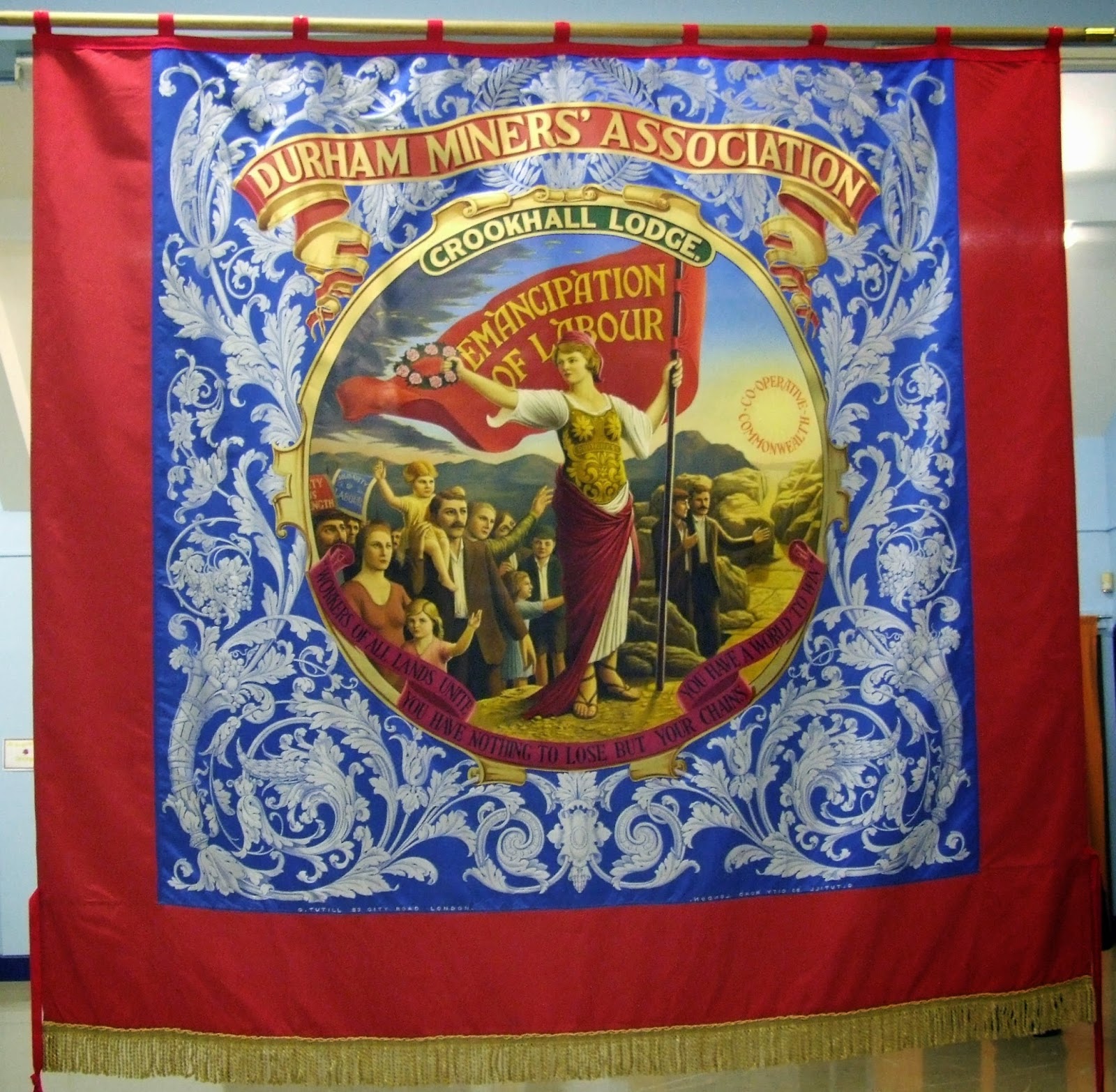
However, the problem I have with these banners is that they really don't represent the traditions of banner-making in British society between the wars. Union branches, Masonic lodges, co-operative societies, brass bands, the Women's Institute, the Boy's Brigade - loads of organisations had banners. People were well used to them, they marched behind them, loads of people must have worked on them. So how come these flags look like they were quickly designed by someone with no graphical talent?

They should really be more like this, I think:


When I work out how to get the scrolly text, elaborate backgrounds and portriature, then perhaps I'll be able to make some banners that really represent the traditions of British banner-making.


Monday, 26 January 2015

Some VBCW flags

Top to Bottom: Black Order (D. Gray-man); Sir Galahad (Monty Python & the Holy Grail); Kingdom of Symphonia (Rave Master); Southern Cross (Fist of the North Star); alternate Southern Cross flag
OK, I basically stole a whole bunch of logos, flags and badges from the excellent 'Flags of the World' website - specifically the 'Fictional Flags' section here - and made some St George's Cross flags. Then I plonked the badges on the flags to represent some Anglican League unit flags, should anyone require them. If I get round to actually doing some VBCW, I think I might well be using them. The bottom two are alternative versions of the same thing, obviously, because there were two different versions of the 'Southern Cross' logo.

My assumption is that the Anglican League is using versions of the St George Cross. The fascist forces are mostly using red flags with black and white designs in roundels, and the socialists will be using red flags with stars and writing. More examples will no doubt be forthcoming at various points...

Not sure how big these are going to be in the end, they may need re-sizing. Hopefully downward.

Saturday, 24 January 2015

Has a year gone by so fast?

Really, it's been two years. Very little progress on the VSF front since March 2013 or there abouts I'm afraid. I've been doing more things with Fantasy, I suppose, but even then last year was pretty empty of painting opportunities.

And this isn't going to help much, as it's about VBCW, which is something that has been simmering away under the surface for a long while now. As not much gets done re: VBCW, there's no point it having a blog of its own so I've put stuff up here before - I think about 5 years ago, I posted about some plastic Cluedo figures I'd got hold of and was thinking of using for '20s-'30s gaming (in fact here they are in their raw plastic state).

Well, that's still ongoing. What I have done is thought of some rules for them - at least, for VBCW skirmishes.

VBCW is a bit weird. The main things about it that I'm pulling into my gaming are that there are 3 factions - the Socialists, the Anglicans and the Fascists - and there are lots of card activations that happen.

So I was thinking what I could do with the Cluedo characters and decided on a few simple rules.

First - the Cludo characters would be 'card activated' too. If a player drew a card, that character would wander into the skirmish and get involved. That means I need six cards - one each for Miss Scarlett, Professor Plum, Mrs. White, Reverend Green (in versions outside the UK, I believe this is 'Mr. Green, the Businessman' but in the UK version he's a clergyman), Mrs. Peacock and Colonel Mustard.

Second - each character would grant some bonus. This I decided was quite tricky. Colonel Mustard I thought should be a combat bonus. Professor Plum maybe a bonus to shooting? A lecture on ballistics or something that increased a unit's ability to shoot. Then I realised I could pair up 'opposites'; and there are a lot of opposites in VBCW.

Third -each character would have some affiliation. The idea of affiliation is a bit weird though. There are three sides, but not every game has three sides. So affiliation can also work negatively and this is what I decided to concentrate on. Who wouldn't someone ally with?

So taking the last question first, I decided that straight off the bat that neither Colonel Mustard nor Mrs Peacock would side with the Socialists. Colonel Mustard is too military to fight for the Bolshies, and Mrs Peacock is too rich and aristocratic. They'd either fight for the Anglicans or the Fascists. So I needed to work out who wouldn't fight for the other factions.

Reverend Green obviously would fight for the Anglicans, but we already have two Anglican/Fascist characters - what I needed was two who would fight for Anglicans or Socialists, and two who would fight for Socialists or Fascists. As there seemed no reason for Reverend Green to avoid the Anglicans (in fact it seemed daft) he was down for Anglican/Socialist. And the pattern of opposites (and abilities) began to emerge.

I'd already reasoned that Colonel Mustard would boost fighting; and Mrs Peacock could perhaps show some chaps how to handle a gun, bein' a huntin' shootin' and fishin' type herself. Prof Plum could also be an expert on guns... so if I made a wheel, and put Prof Plum opposite Mrs Peacock...
That's how it came together in my head. Each character has a primary allegiance - Plum and White to the Socialists, Scarlett and Mustard to the Fascists, and Green and Peacock to the Anglicans. But because of where they 'never' go, each character also has a secondary allegiance. Plum and Scarlett, I decided, were far to unconventional ever to join the Anglicans. And I already knew that Mustard and Peacock would never join the Socialists.

So this way, in a two faction battle, each side could get three allies. In a fight between Socialists and Fascists, Mrs Peacock would join the Fascists with Miss Scarlett and Col. Mustard; Rev. Green would join the Socialists with Prof. Plum and Mrs White. In a fight between Socialists and Anglicans, Miss Scarlet would join the Socialists with Plum and White, against the Anglicans with Green, Peacock and Mustard. And in a fight between Anglicans and Fascists, White would join the Anglican side while Plum allied with the Fascists.

The abilities each has paired up quite neatly too. Reverend Green's effect on morale (a nice sermon to rouse the Anglicans, or a bit of fiery Christian Socialism for the 'redder' troops) balances Miss Scarlett's singing (I imagine her as a sort of celebrity coming to to entertain the troops); Col Mustard teaching hand-to-hand combat balances Mrs White fortifying the troops with tea; Professor Plum's ballistics lectures complement Mrs Peacock's teaching of the same subject. And the way the forces split means no-one would ever be on the same side as their 'opposite' with the same skills.

There will be two ways these characters can be used. If one draws a card with a character from 'ones own' army - let's assume, it's Socialists v Anglicans and the Socialist player draws Mrs White - then that player gets to place the Mrs White figure with whichever of his units he wishes, as she has wandered into the battle with a tray of tea 'for the lads'. All effects take one turn to come into play: for that turn the chosen unit cannot attack, but after that, for the remainder of the game, that unit counts as having a bonus to hand-to-hand attacks (exactly what bonus would depend on the games system of course). But anyway, the Miners' Militia, fortified by a turn of drinking tea, later assaults the enemy's positions with renewed vigour.

On the following turn, the Anglican player draws - calamity! - Miss Scarlett, an 'enemy' card. The Anglican player can't play Miss Scarlett in his own army but can, perhaps, still use her to his advantage. As Miss Scarlett's ability is improving morale, it would be best to 'waste' this ability on either a unit with high morale anyway (so the increment is not noticed so much) or on a unit unlikely to have to check morale. The Anglican player has a choice - place Miss Scarlett with the enemy command (where she may distract them with her singing thus possibly preventing them giving orders, depending on the system, but in any case unlikely to need an increase in morale) or with that unit of snipers hiding in the trees, who have to stop shooting for a turn in order to be entertained - even though they're unlikely to be making a morale check.

This latter effect, where a friendly character is placed by the enemy, can be regarded as the result of misinformation or deception by spies or double agents. Not the characters themselves - but whoever sent Miss Scarlett there at just that time - obviously, working for the Anglican League...

So where does this all leave VSF? I'm still working on ways to include these six into 'Torchwood: 1891' but without the three-fold alliance structure it's difficult to see how something like this is applicable. I think I might go back to my original idea to link them to D&D-type abilities: Strength, Intelligence, Wisdom (Fighter, Wizard, Cleric, Mustard, Plum, Green?), then perhaps Scarlett could represent Dexterity (and Thieving?) White could represent Constitution (generally fortitude and endurance) and Mrs Peacock Charisma - as a 'lady' she was probably born to rule...

Still thinking about that - I'd say 'watch this space' but if it's another year until I post you might get round to thinking that I was a bit presumptive!

Wednesday, 29 January 2014

Death of Lord Burlesdon


Full text of the obituary is...


It is with great sadness that this newspaper must report the death at his London home on Saturday last of Robert James Augustus Hugh St John Bathley Crane Rassendyll, 12th Earl of Burlesdon and 29th Baron Rassendyll.

Countess Burlesdon has confirmed that the Earl became ill during a stay at Burlesdon House over the New Year. Returning to London to consult with the Earl’s doctor, it was found that the illness had rapidly progressed, and after too-vigorous a Burns’ Night Supper on Thursday last, the Earl took to his bed, and gave up his life during the night of Saturday 27th.

The late Earl’s eldest son, John Heatherley St. John Augustus James Hannay Rassendyll succeeds his father as the 13th Earl of Burlesdon and 30th Baron Rassendyll.

Born at the family’s London residence in Park Lane in 1840 to his parents James, the 11th Earl and Lady Charlotte, daughter of Augustus and Philomena Bathley-Crane of Devonshire, and named for his late uncle Robert, the 10th Earl who had died two months before, the young Robert Rassendyll spent much of his childhood in North Surrey, at Burlesdon on the family estate.

He was educated at Rugby, Jordan College Oxford, where he studied Political Science, Divinity and German Literature, and the English University of Weser-Dreiburg. Following his successful matriculation, he achieved a commission in the Royal North Surreys, a regiment with which his family has been intimately connected, and served with distinction in the First Kamistan Campaign and then the Matoboland Wars, rising quickly to the rank of Major.

After resigning his commission in 1867, he returned to Burlesdon and married Miss Rose Virginia Constance Heatherley, daughter of Jebediah Heatherley of Esher, the noted manufacturer of marmalade. Over the next eight years, the Countess bore him six children, John, William, Henry, James, Constance and Gustave, who were brought up at Burlesdon in the idyllic surroundings of the family estate.

Following his marriage he stood for election to the North Surrey parliamentary constituency in June 1868 for the Liberal Party, and took the seat with a majority of 3,461. A follower of the maxim ‘change is too important to be rushed’ he was also the author of several works of political philosophy, including ‘The Ultimate Outcome’, and ‘Ancient Theories and Modern Facts’.

The late Earl regarded himself as a ‘conservative Liberal’ and served under Prime Ministers from both parties. His first government position, serving under Lord Fotherington-Thomas, in the Liberal administration of Lord Marlingbury, was from 1869 as Under-Secretary for Indian Affairs, where he put his intimate knowledge of the Kamistan situation to good use. In 1873 he joined the first Conservative administration of Lord Crindlehurst, also holding a position in the Imperial and Foreign Service. He resigned from his post on the death of his father, the 11th Earl, the following year, and returned to Burlesdon.

The life of the Earl has not been devoid of tragedy. Nine years ago, the Earl’s brother Rudolf Rassendyll, a former Captain of the 27th Lancers, was killed during a visit to Ruritania. The exact circumstances of Mr. Rassendyll’s visit have never been made public but the Ruritanian Government has issued a statement to the effect that Mr. Rassendyll was working in a personal capacity for the Royal Family, when he was attacked by agents of Count Rupert of Hentzau, a notorious villain who was later killed by the late King, Rudolf V of the House of Elphberg, in a duel occasioned by an attempted assassination.

Lord Robert will be fondly remembered, especially by the inhabitants of Great Burlesdon, for his generosity and concern for the welfare of the simple folk who live there. He sponsored the provision of the electrical and gas supplies to the village, and no blame can be attached to the late Earl for the unfortunately fatal incident that occurred shortly after the supplies were connected. A patron of the Parish Church of St. Igwulfa and St. Michael at Burlesdon, his strong singing voice was a welcome addition to morning Psalms and will be sorely missed by the congregation there.

The body of the late Earl will be conveyed to Burlesdon House, where it will lie in state until the morning of the 17th of February; the funeral will take place at the Church of St. Igwulfa and St. Michael at 1 o’clock.

Tuesday, 21 January 2014

Apologies and other such fumblings

Well; real life (and also other gaming projects) took a bit of a toll over the second half of last year, but in the midst of it all I put in an order with Ironclad and snagged a bunch of their lovely minis. Some Prussians and whatnot, which will be going to wards my Ruritanian/Astro-Hungarian Empire forces (some for use on Earth, some for Mars...), and few other things.


 And then I got another set of Northstar miniatures for IHMN, this time the 'Whitechapel Anarchists' set. Still havent played a game, but maybe someday!


And I've just put in a Reaper order - mostly for other games projects I have to admit, but including a couple of Steampunk-esque figures - possibly for use as some of Kaptein van Dango's Sky Pirates, maybe - because I had to really.


Yes, there will be photos - at some point; no, none of this currently has any paint on at all.